I recently had the pleasure to join the
64th NANOG (North American Network
Operators’ Group) meeting in San Francisco, which can be understood as one of
the largest Internet engineering conferences at all. It takes place three times
a year at different locations in North America.
What I personally like about NANOG is its strong collaborative and cooperative
character. It is not about single persons and also not too much about
spectacular projects but more about discussing technologies, ideas, challenges
and numbers. Every talk has a comparatively large time slot reserved for
discussion, which is often more than fully used. Discussion is typically
actively focused and is more time-consuming (and even more relevant) than the
talk itself. Which often is intended by the community. The climate of discussion
is almost always impressively polite and constructive, even for controversially
discussed topics.
In the course of a customer project I recently documented some thoughts and
general objectives of IPv6 address planning, expanding on stuff I wrote a while
ago in the
series on “Address Plan Considerations”.
An excerpt of that (newer) document
can be found here.
Due to the context it originates from it’s in German, still I hope it’s useful
for some readers.
If you’re interested in the topic it might be a good idea to listen to
Tom Coffeen‘s talk at the upcoming
IPv6 Business Conference, too.
I wrote a small python script that extracts the content from Alcatel .tim
firmware files. It took some time staring at hex values, as well as a fair
amount of guess work to figure out the file format.
All .tim files start with a common header, containing the TiMOS version string,
the build string, the used compression algorithm and the number of segments
included in the file. The common header is followed by a header for each segment
in the file. The segment header contains values like the name of the segment,
the beginning of the segment in the image file, the size of the segment,
compressed as well as extracted, a checksum of the decompressed data and also
the base address and entry point of the data in the routers memory. A segment
header can look like this:
There has been, again, some development within the loki domain. Today I’m going
to write about the latest module added to the suite, a module for decoding and
cracking Cisco’s TACACS+.
TACACS is the Terminal Access Controller Access-Control System, a protocol for
handling remote user authentication and central access control. It originated in
1984 and was used in the old Unix world. TACACS+ is a related protocol developed
by Cisco Systems and is widely used for AAA (Authentication, Authorization,
Accounting) on IOS based devices. It was released as an
open standard in 1993 (and
expired in 1998 by the way ;-)).
End of May eight ERNW members were travelling to Moscow (Russia) to visit the
PHDays V conference. It was a very nice trip
because we met a lot of gentle people, ate some great food and had quite
some fun in this exciting and history-charged metropole, and we were able to get
around using hands and feet (and Google translate ;-)).
The remainder of this post contains summaries of some of the most interesting
talks at PHD V:
I’m back from London where I gave a talk about security evaluation of
proprietary network protocols. I had a great time at
InfoSecurity Intelligent Defence
and BSides London, many thanks for
inviting me and giving me the opportunity to speak to so much nice people.
Find the abstract and the download link to the slides after the break.
Even in the time of Cloud-based security tools, behavior- and machine
learning-based APT detection and colorful security appliances, a lot of
vulnerabilities are still buried deep within the protocol layers. For security
researchers it is quite a challenge to find those in well documented protocols
(take SSL for an example), and when it comes to proprietary protocols, the bar
is raised even (significantly) higher. This keynote will show that there is
still an urgent need for security evaluation on (undocumented) network
protocols, discuss war stories on protocol fails, and also give an
introduction into the methodology of protocol reversing and how those protocol
fails could have been avoided.
“The security of IPv4 is roughly equivalent to IPv6. So why do we expect more
from IPv6?”
While I highly value Scott’s IPv6 expertise – not least because I learned a lot
about IPv6 security from
the book on the topic
he wrote together with Eric Vyncke – I
strongly disagree with his statement, mainly with the first part. In this post I
will lay out why I think that IPv6 is actually less secure than IPv4.
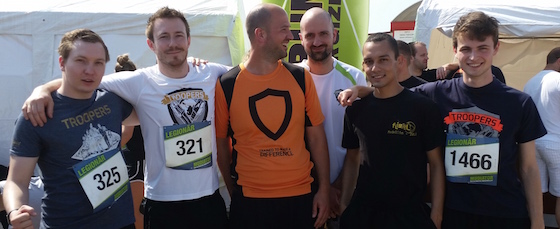
Today the ERNW Team participated in the Mudiator mud
race in
Mannheim.
This mud run features 25 obstacles over 8 km, you can do either one or two
rounds. Participating for the first time, the ERNW team went for one round (the
Legionnaire distance as opposed to the two round Hercules distance):
Following our idea of open access to knowledge (both about vulnerabilities and
sports 😉 ), here are some hints/lessons learned:
The final blog in our series “Beyond the Thunderdome: A Review of TROOPERS15”
focuses Exploitation & Attacking. With the last of this series we hope we you
are already fired up and inspired for what lays a head during our upcoming
TROOPERS16 (March 14-18, 2016)! Can’t wait to see
you there!
“The old is new, again. CVE20112461 is back” talk created and given by Luca
Carettoni and Mauro Gentile
Last week we enjoyed quite a wonderful HAXPO exhibition and HITB conference in
Amsterdam. A number of great talks could be heard at the main HITB conference
such as “Bootkit via SMS: 4G Access Level Security Assessment” or
“Stegosploit: Hacking with Pictures“. And not only that: there were also
several engaging hands-on workshops.
Apart from the main conference, there was the HAXPO – a hacker exhibition. At
this exhibition you could connect with people from different companies, get a
lot of merchandise, and also listen to several briefings on security and its
philosophy. Fortunately, we had the pleasure to present two of these briefings
and maybe you tested your web application skills at the ERNW booth.