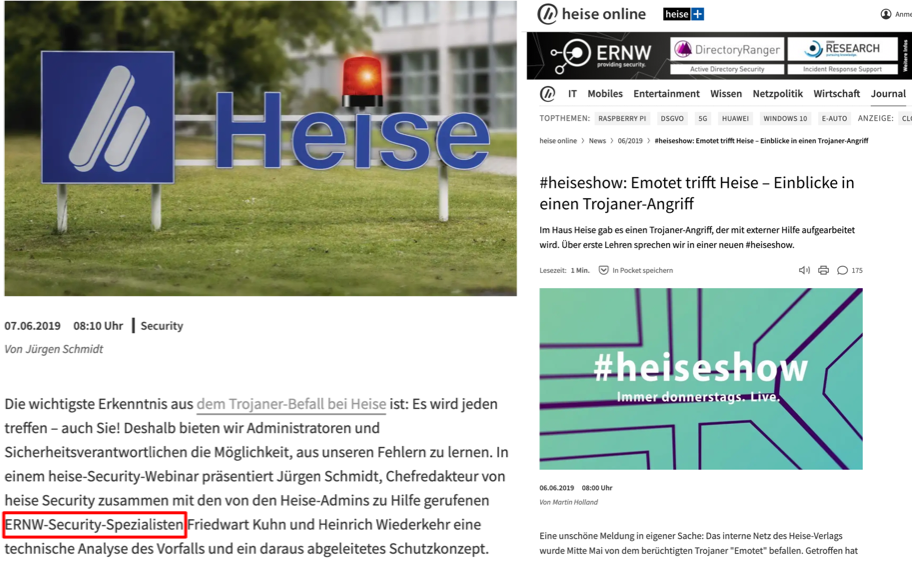
After the Emotet Incident at Heise, where ERNW has been consulted for Incident Response, we decided to start a blogpost series, in which we want to regularly report on current attacks that we observe. In particular we want to provide details about the utilized pieces of malware, different stages, and techniques used for the initial infection and lateral movement. We hope that this information might help you to detect ongoing incidents, apply countermeasures, and in the best case to figure out proactive countermeasures and security controls beforehand.
In some organizations we work with a certain state of IPv6 deployment has been reached in the interim which includes, among others, the following aspects:
the network infrastructure is IPv6-enabled (incl. interface addressing, routing [protocols] and the like).
parts of supporting services (security functions, monitoring, system management) include IPv6 in a proper way.
3rd party providers have been contractually obliged to deliver their services in an “IPv6-enabled” mode (as opposed to only being “IPv6-capable” which was the standard requirement in many RFIs during earlier years).
It might then happen that networking people (who often are the initial motivators for deploying IPv6) in such organizations are stating, when asked about IPv6: “it’s [mostly] done”.
Point is that, alas, this does not necessarily mean that a single service or application is *actually using* IPv6, so while the above certainly constitutes an achievement it might not even be halfway through.
The Windows Insight repository currently hosts four articles on VSM (Virtual Secure Mode):
Virtual Secure Mode: Architecture Overview (Aleksandar Milenkoski): In this work, we discuss the architecture of a virtualized Windows environment.
Virtual Secure Mode: Communication Interfaces (Aleksandar Milenkoski): In this work, we discuss the communication interfaces that VSM implements: Isolated User Mode (IUM) system calls, normal-mode services, secure services, and hypercalls.
Virtual Secure Mode: Protections of Communication Interfaces (Aleksandar Milenkoski): This work discusses implemented mechanisms for securing the above VSM communication interfaces. This includes restrictions on issuing hypercalls, data marshalling and sanitization, and secure data sharing.
Virtual Secure Mode: Initialization (Dominik Phillips, Aleksandar Milenkoski): This work describes the process for VSM initialization activities performed by the Windows loader and the Windows kernel when Windows 10 is booted.
Heise berichtet aktuell öffentlich über die Emotet-Infektion im eigenen Haus, bei dessen Aufklärung ERNW unterstützte. Damit liefert Heise Informationen zum Verlauf aktueller Angriffe, aber insbesondere auch wertvolle Einsichten zu Vorbeugung, Erkennung, Analyse und Gegenmaßnahmen aus eigener Erfahrung, wie sie nur selten der Öffentlichkeit preisgegeben werden.
Ein Team aus Incident-Response Spezialisten der ERNW Research unterstützte Heise bei der Analyse und Rekonstruktion des Vorfalls und analysierte die Schadsoftware, um deren Ausbreitungswege nachzuvollziehen und IoCs (Indicators of Compromise) zu extrahieren. Hierdurch konnten effektive Gegenmaßnahmen entwickelt und gemeinsam mit Heise erfolgreich umgesetzt werden.
Im Zuge dessen unterstützten Active-Directory-Spezialisten der ERNW Heise bei der Konzeption und dem Wiederaufbau eines neuen Active Directory. Im heisec-Webinar am 3. Juli berichtet Heise über den Incident und die wichtigsten Erkenntnisse daraus. Dabei sein werden zwei unserer Active Directory-Security-Spezialisten. Sie werden Konzepte und Verfahren für ein sicheres, resilientes und trotzdem betreibbares Active Directory vorstellen und den Teilnehmern mit Tipps für Containment nach einer Infektion und in gemeinsamer Diskussion zur Verfügung stehen.
The Windows Insight repository currently hosts three articles on the TPM (Trusted Platform Module):
The TPM: Communication Interfaces (Aleksandar Milenkoski): In this work, we discuss how the different components of the Windows 10 operating system deployed in user-land and in kernel-land, use the TPM. We focus on the communication interfaces between Windows 10 and the TPM. In addition, we discuss the construction of TPM usage profiles, that is, information on system entities communicating with the TPM as well as on communication patterns and frequencies;
The TPM: Integrity Measurement (Aleksandar Milenkoski): In this work, we discuss the integrity measurement mechanism of Windows 10 and the role that the TPM plays
as part of it. This mechanism, among other things, implements the production of measurement data. This involves calculation of hashes of relevant executable files or of code sequences at every system startup. It also involves the storage of these hashes and relevant related data in log files for later analysis;
This week Chris and I participated in the RIPE 78 meeting in Reykjavík. Being part of the group was fun as always and we had quite some interesting conversations with peers from (not only) the IPv6 community.
Big thanks to the RIPE NCC team for the smooth organization and for taking care of us!
In this post I’ll provide some notes on talks I found particularly interesting, plus links to our own contributions.
We are glad to announce the Windows Insight repository. The content of this repository aims to assist efforts on analysing inner working principles, functionalities, and properties of the Microsoft Windows operating system. This repository stores relevant documentation as well as executable files needed for conducting analysis studies.
Some of the content of this repository has been created in the course of a project named ‘Studie zu Systemaufbau, Protokollierung, Härtung und Sicherheitsfunktionen in Windows 10 (SiSyPHuS Win10)’ (ger.) – ‘Study of system design, logging, hardening, and security functions in Windows 10’ (eng.). This project has been contracted by the German Federal Office for Information Security (ger., Bundesamt für Sicherheit in der Informationstechnik – BSI). The work planned as part of the project is conducted by ERNW GmbH, starting in May 2017.
Chris and I will give a tutorial on the above topic at next week’s RIPE Meeting in Reykjavík. In this post (actually this will probably become a small series of posts) I’ll try to summarize some thoughts on IPv6 security in enterprise environments in 2019.
Dominik Phillips and I are taking part in a tour organized by Heise Security – the Heise Security Tour. We give a talk titled “PowerShell: Attack under the radar”. In this talk, we provide an overview of the architecture of PowerShell and show how attackers may use PowerShell for malicious purposes. We demonstrate PowerShell post-exploitation activities implemented as part of publicly available frameworks, such as Empire. We also discuss a security concept for defending against such activities.
You can find the slides of our talk here (in German).