The CTL is basically a binary TLV file with 1 byte type, followed by 2 bytes
length and finally the data. But as this is far to easy, some special fields
omit the length field and just place the data after the type (I guess those are
fields with a fixed length). Here is an example CTL file:
Some of you may have heard the topic before, as we have spoken about on this
years BlackHat Europe, TROOPERS12 and HES12,
so this is nothing completely new, but as we’re done with responsible disclosure
(finally (-; ) and all the stuff should be fixed, we’re going to publish the
code that brought us there. I will split the topic into two blog posts, this one
will wrap up the setup, used components and protocols, the next one [tbd. till
EOY, hopefully] will get into detail on the tools and techniques we used to
break the enterprise grade security.
We’re delighted to provide the first announcement of talks of next year’s
Troopers edition. Looks like it’s going to be a great event again 😉
Here we go:
==================
Peter Kieseberg: Malicious pixels – QR-codes as attack vectors.
**Synopsis: **QR-Codes, a version of two-dimensional barcodes that are able to
store quite large amounts of information, started gaining huge popularity
throughout the last few years, including all sorts of new applications for them.
Originating from the area of logistics, they found their ways into marketing and
since the rise of modern smartphones with their ability to scan them in the
street; they can be found virtually everywhere, often linking to sites on the
internet. Currently even standards for paying using QR-codes were proposed and
standardized. In this talk we will highlight possible attack vectors arising
from the use of QR-Codes. Furthermore we will outline an algorithm for
calculating near-collisions in order to launch phishing attacks and we will
demonstrate the practical utilization of this technique.
2 AFFECTED PRODUCTS The following Products have been tested as vulnerable so far: Cisco Unified Meetingplace with the following modules: • MeetingPlace Agent 7.1.1.9 • MeetingPlace Audio Service 7.1.1.8 • MeetingPlace Gateway SIM 7.1.1.2 • MeetingPlace Replication Service 7.1.1.9 • MeetingPlace Master Service 7.1.1.8 • MeetingPlace Extension 7.1.1.8 • MeetingPlace Authentication Filter 7.1.1.8
3 DETAILS The following parameters are affected: http://$IP/mpweb/scripts/mpx.dll [POST Parameter wcRecurMtgID]
4 VULNERABILITY SCORING The severity rating based on CVSS Version 2: Base Vector: (AV:N / AC:L / Au:S / C:P / I:P / A:P) CVSS Version 2 Score: 6.5 Severity: Low
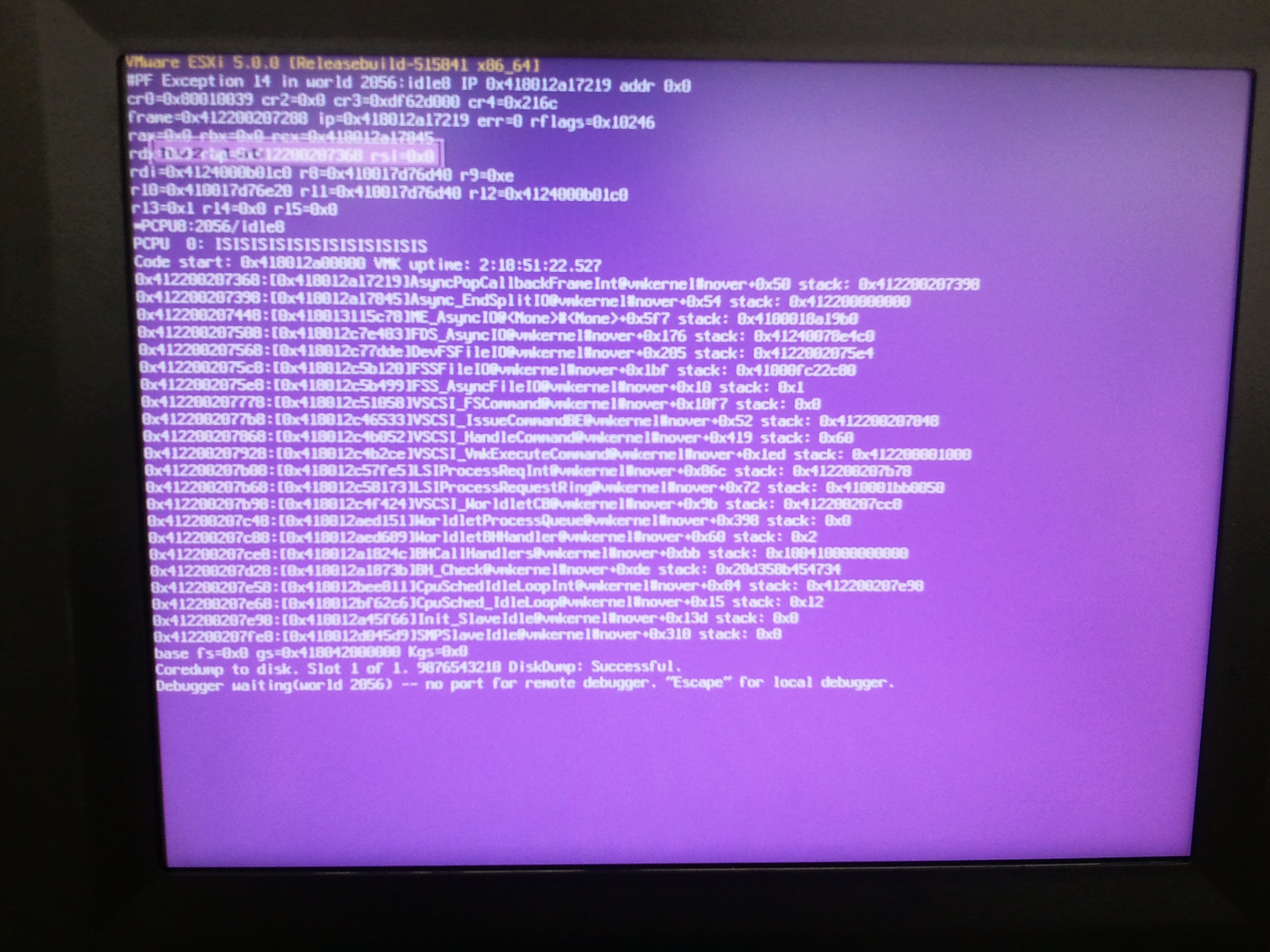
Almost all of our presentations and write-ups on the VMDK File Inclusion
Vulnerability contained a slide stating something like
“we’re rather sure that DoS is possible as well ;-)”
including the following screenshot of the ESX purple screen of death:
So it seems like we still owe you that one — sorry for the delay! However the
actual attack to trigger this purple screen was rather simple: Just include
multiple VMDK raw files that cannot be aligned with 512 Byte blocks — e.g.
several files of 512 * X + [0 < Y < 512] Bytes. Writing to a virtual hard
drive composed of such single files for a short amount of time (typically one to
three minutes, this is what we observed in our lab) triggered the purple screen
on both ESXi4 and ESXi5 — at least for a patch level earlier than
Releasebuild-515841/March 2012: it seems like this vulnerability was patched in
Patch
ESXi500-201203201-UG.
Two weeks ago we had a great time at
Day-Con VI. Enno, Matthias, Rene, Frank and
me traveled to Dayton, OH to give workshops and presentations. We started a
tough week full of workshops on Tuesday where
Rene gave a deep inside look into the world of security on current mobile
platforms. Matthias discussed security problems and possible design patterns of
cloud environments in his Cloud & Virtualization Security Workshop before he
gave a first insight into the world of reverse engineering on Wednesday. Frank
and me taught the basics of hacking and pentesting in the
PacketWars bootcamp (comparable to the one at
TROOPERS),
preparing the participants for the
PacketWars on Saturday. Obviously we were
not the only ones having a
great time
😉
pytacle is a tool inspired
by
tentacle.
It automates the task of sniffing GSM frames of the air, extracting the key
exchange, feeding kraken with the key
material and finally decode/decrypt the voice data. All You need is a
USRP (or similar) to capture the GSM band and a
kraken instance with the
berlin tables (only
about 2TB 😉 )
I’ve posted a preview
before, take a look at the video to see the tool in action.
Microsoft takes this vulnerability quite serious and was acting fast. The
Microsoft Security Response Center announced the availability of a fix last
night in the
MSRC Blog.
The fix will be available via Windows Update on friday, the 21st of september.
So it’s time to get ready for this update ;-).
Actually a Windows Vulnerability
(Microsoft Advisory 2757760) related
to the Internet Explorer Version 7, 8 and 9 is in the news. Microsoft is aware
of the problem, but there’s no patch available yet. We call this a 0-Day :-).
Making the problem even worse, on monday reliable
exploit code
was released within the Metasploit project, so exploit code is already in the
wild.
Disabling Active X and Active Scripting in the Internet Settings
But both of them have some impact: EMET must be deployed before any usage (btw.
EMET can be configured via Group Policies) and disabling Active X and Active
Scripting might break some business relevant web sites (that can be added to the
“Trusted Sites” Zone, but might produce major operational effort).