Puh…it’s been a long time since my
last post,
huh?
However, let’s get straight back to topic. Today, I want to issue a warning,
especially in face of upcoming
Troopers 2017 (less than two days to go,
wooo! 10th anniversary!): be careful when using wireless equipment (presenters,
mouses, keyboards,…), especially during Troopers, but also in daily use.
TL;DR Please take into account that you put your laptop at risk of being hacked
by using wireless equipment during Troopers. This
could lead to a full system compromise. Wirelessly. Attacks like keystroke
injection or sniffing of latter and mouse movements are possible. This, e.g.
applies to speakers, using wireless presenters (like Logitech R400/R800, old and
new models), as also to any attendee or crew member who might use
wireless mouses or keyboards. Be aware of this!
Last Friday I gave a talk at the ITSeCX in St.
Pölten, Austria. The conference, hosted by the local University of Applied
Sciences, has already taken place ten times. I don’t know how many people
attended this time, 2014 there were about 600;
I read somewhere on the net.
There were four tracks and some workshops from 4pm to the conference’s end at
midnight. I enjoyed the community-feeling there very much, even though I arrived
late. The only talks I saw, were Adrian Dabrowski speaking about the DARPA Cyber
Grand Challenge, the finals took part in Las Vegas this August, and the very
entertaining end-of-year review from two UAS guys.
Just a short recap from my side regarding this year’s BSide in Las Vegas, NV. It
was my first time there and I pretty much enjoyed it. After entering the venue
on the first con day (Tuesday) I was a little bit shocked, as the staff sent me
to the “end of the line just around the corner” – the end being many corners and
many floors away 😉 Speaking to some guys while standing in line, time quickly
passed by and before finally hitting the registration desk, there were already
some people from the staff giving away the conference badges to the waiting
folks. The waiting time was no comparison to last year’s DEF CON, where I (and
obviously all the other “humans”, how attendees at DEF CON are called) had to
wait nearly _four_ hours to get a badge to enter the con. DEF CON staff
already calls this the annual “Line Con”. Enough bashing, back to topic 😉
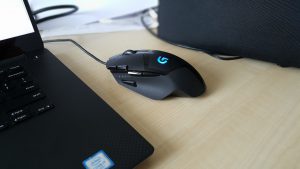
Ever got a backdoor installed on your computer by your beloved mouse? Here’s the
story of a poor mouse that got really, really sick.
Agent “Danger Mouse”
Do you remember the times where people put Teensy-boards and USB hubs in their
mouses? [Chris? ;)] Their aim was to attach an additional
Human Interface Device
(HID, like keyboards or mouses) with some payload in kind of e.g. keystrokes or
mouse movements. Also, there are devices available like the USB Rubber Ducky in
the housing of a USB thumb drive.
The principle is easy: The tools are using a programmable microcontroller with
the capability to emulate USB HID. That’s it. Just program your board of choice
with the payload fitting your needs and plug it in at the target computer. The
latter will recognize it as a keyboard/mouse and the payload-keystrokes will be
entered.
But why should external hardware be used? Many modern gaming peripherals provide
functions to store macros on them, including enough onboard memory for little
payloads.
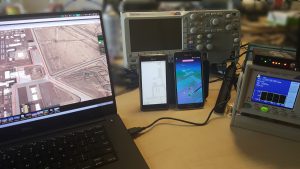
The moment, when your team leader asks you to cheat at Pokémon GO…everyone knows
it, right? No? Well, I do 😉
GPS Spoofing Setup
As I’m not a gamer, the technical part was of much more interest – that’s the
real gaming for me.
So, challenge accepted!
In the past I was often fiddling around with SDR (Software Defined Radio),
started with DVB-T sticks some years ago. When I came to ERNW in 2014 I got in
touch with
Michael Ossman’s great HackRF One for
the first time, and subsequently my thesis was based on SDR.
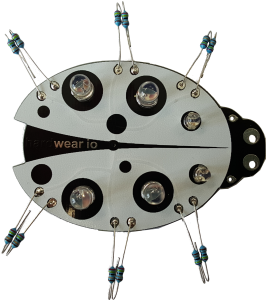
We couldn’t be more proud to welcome such a predestined #1 hardware hacking
victim, than VICTor is!
Before Brian and I gave a lecture on hardware hacking last week at
DHBW Mosbach, we felt, that we needed a custom
victim which is fully documented and provides a good “hackability” to the
students.
Surely we could also have used some cheap $wifi_ap, but here’s the thing: Would
you really want to use a device which you don’t really know? Mostly, there’s a
massive lack of documentation regarding the SoCs used…not to mention the
unavailability of schematics and layouts.
As we wanted to teach students the basics of hardware hacking effectively, we
decided to create something by ourselves.
Last week I had the pleasure to attend the “escar” (Embedded Security in
Cars) conference in Cologne, Germany.
Arriving late Tuesday, I had the chance to get a rich breakfast before joining
the con in the hotel Dorint at Cologne’s famous place the Heumarkt.
Unfortunately I had to deal with two stumbling blocks on my way to the Dobrint:
The magnetic sensor of my mobile which went crazy (no compass) and – the date.
11th of November in Cologne means just one thing – carneval! The whole
city was just in a state of exception. Everybody on my way to the venue seemed
to be drinking or beeing already drunk – at 9am! 😉
Being a little late, I went straight to the room after registration. As there
was only one track to follow you could not miss any talk – nice thing!
After we were welcomed by the hosts, and the first talk started.
On October 1st and 2nd Flo and I were presenting at
hardwear.io in The Hague, NL. My topic was
“Living in a fool’s wireless-secured paradise”
and Flo was presenting his current research
on medical device security. It was the first talk at an international
security conference for me and I am still quite excited!
I was speaking about the (in)security of wireless consumer alarm
systems, which you can buy just in every consumer electronics store
around the corner for about $10 – $250. I analyzed the systems on
different levels, e.g. looking at UART and JTAG and the wireless domain
with Software Defined Radio (SDR). I gave an overview of my current
research and the tools I usually use for hardware hacking, especially my
favorite thing to play with: SDR.