Welcome to Brazil!
“Welcome to Brazil”, I think, turned to being the most used statement during the past Hackers to Hackers Conference in Sao Paulo. It was used as the main reaction to every speech taking moment, and there were a lot of those! To honor the moments and give you a quick insight into was what going on in Sao Paulo, here is a quick summary of the overall event and our own contribution.
To keep it in chronological order, the weekend started on Friday at the House of Learning, which was this year’s location for Sacicon. Sacicon is a sweet little invite only conference with just a few people. It actually is the only Brazilian IT-Security conference, which is completely held in English. This year’s speakers included Bryan Fite, PaX Team, Gabriel Barbossa and Hendrik and me.
Here Hendrik and I held a short talk on cellular networks, their vulnerabilities
and a few things we learned from running our own GSM network at TROOPERS. The
talk was admittedly tributed to one of our TROOPERS attendees, who was not
amused, when he entered the venue and his phone (due to being foreign and in
roaming state) jumped into the TROOPERS network. When he received the welcome
text message, well, he prefers the airplane mode now! So greetings in his
direction from here: Thanks for the inspiration for the talk.
Sacicon offers a very familiar atmosphere and so the talks included some
interesting details and resulted in various discussions. In summary – just
great!
Big thanks to the guys from the House of Learning!
Saturday
Then on Saturday, the first day of the conference, we were yet again surrounded
by the many friends we made during last year’s H2HC and other conferences. The
line of speakers, which included PaX Team, Ilfak Guilfanov and Vladimir
Wolstencroft resulted in a great set of highly interesting talks. Most of the
held talks were recorded and should be published beginning of 2016 (probably!).
As always H2HC was accompanied by the H2HC University, which is a set of
workshops for beginners and proficient people on various topics of IT security.
Seems they also had a great line up!
Hendrik and I had also joined the line of H2HC speakers to present on some of
our experience in the field of physical access and hardware hacking. The talk
contained an overview of interfaces which are usually contained in all devices,
but are often forgotten or not accounted for. For the talk we sorted these
interfaces into three categories: “Maintenance”, “Service”, “Fallback” and
“Internal Communication”. Here Maintenance summarizes the interfaces, which are
used by service engineers, field technicians and sometimes even Admins for
setting up or configuring the device. Service, although it’s probably a badly
selected term, summarizes the interfaces, which will be used for
debugging/fixing, when a device is sent back to the manufacturer. Fallback
interfaces are, well, used when something has gone wrong and access needs to be
kept available. And last, but not least, Internal Communication was a selection
of interface which are necessary for a device to work (like the wires between a
memory chip and a controller).
Using these groups and a few random examples like smart phones, thin clients and
also the eNodeB from our telco lab, we showed that are large amount of hardware
out there is vulnerable to very simple attacks. As the eNodeB is kind of an
intersection between Hendrik’s (telco) and my (hardware) some focus went into
this topic. Here we showed how helpful it is, when connectors on a devices PCB
are actually marked as being serial or JTAG interfaces. Or when the device’s
firmware is stored on a removable Compact Flash card directly on the center of
the main PCB. Or when the device contains a maintenance interface with hardcoded
credentials. Or when the device has a configuration tool, which you can’t run
because it’s only compatible with JAVA 1.5 running on a Win XP / 2000. Or when…I
guess you get the point. As such the eNodeB resulted in being a great case
study, with vulnerabilities in all mentioned categories.
The talk ended with a very simple conclusion, very many devices out there can be
easily attacked, by using $20 worth of tools and little experience. Some of
this results from the reuse of old components, some from needing accessibility
in case of errors and very very much from the fact that chips need to be able to
talk to each other for a device to work. Sadly, a few of these flaws can only be
patched up by obscurity Make sure that the attacker will break the device
rather than extract data.
To keep it simple, do not put too much trust into your everyday electronic
devices and give hardware hacking a try!
Directly after our talk, followed a small workshop on the H2HC 2015 electronic
badge, of which I had the honor to design it. Having enjoyed H2HC in 2014 and
being in regular contact with Rodrigo, we had worked out to give an electronic
badge for the 2015 edition a try. And this is the result:
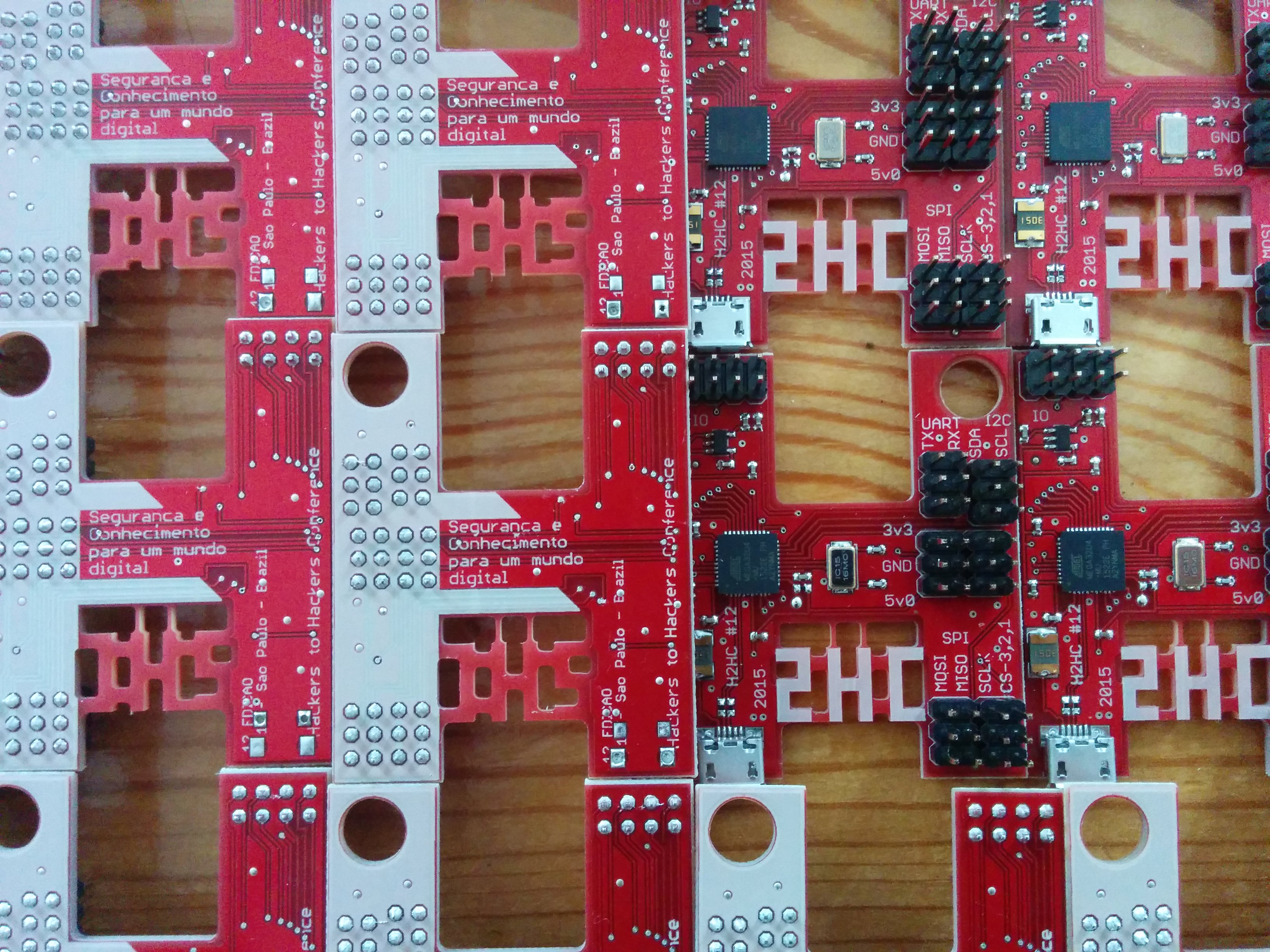
The badge is basically an
Arduino Leonardo in a
customized design. Using the same ATMega32U4 the badge offers 28kb of flash
memory (the chip has 32kb, but 4 are used by the bootloader) and a
straightforward way of programming it via USB. Using Arduino Studio as a source
for libraries and for writing the code, the badge is great for small hardware
projects and for the first (and sophisticated) attacks on any kind of hardware.
To offer a quick start, the badge has multiple IO pins and duplicate headers for
SPI, UART and I²C. Having duplicate headers offers the opportunity to not only
connect the target device but also scopes or logic analyzers for debugging.
The workshop on the badge was something like a quick start guide, presenting
options, functions and a few little ideas. For me, personally, the Arduino is a
very helpful little gadget, which offers an easy start for beginners and can
also be a mighty tool for practical penetration tests and demonstrations. At
some point one will always have to start creating her own tools. So why not
start directly from scratch and get a feeling for the overall approach?
Sunday
Sunday morning, the second and last day of H2HC, we had everything up and
running for a round of Packet Wars in cooperation with
Bryan Fite. A shiny Mac Mini connected to a little Cisco AP were both ready to
play a game of “Hiding from Robots”. Although the setup had already shown a few
weaknesses at DayCon IX, we decided to give it a shot.
Hendrik and Bryan helped all combatants getting connected to the network, while
I walked off to a group of university students who had been invited to join the
hacking. As all seats for the actual contest were already taken, we decided to
give a quick and simple hacking crash course.
As such I gave a quick introduction to the Metasploitable VM and got the guys
going, while Hendrik supported the Packet Wars session. Luckily I had some
support with the students, as the game would turn a little bit ugly.
While Packet Wars was aimed at being a challenge for the combatants, also we as
organizers had a few battles of our own to fight. Directly during the first
round various network and connection problems appeared. One of the teams, Team
3, had large problems staying on the network. These problems got so bad, that
they kind of quit the game during the first round.
From what we’ve seen the problems resulted from three different anomalies:
- The access point seemingly crashed two or three times under the load.
- The SSID of Team 3 was completely missing at certain points and our RF-spectrum analyzer showed some strange peaks. It seems somebody was nicely jamming their frequency.
- Throughout the game, there were multiple de-authentication attacks against the WiFi clients. These seem to have been coming from more than one party.
As RF is a pig, it was sadly not possible to identify the exact source of the
attacks and stop them. Still, even though the attacks did not stop, the teams
seemed to just stay motivated to finish the game until about the middle of the
third round. And while we felt sorry for everybody who could not properly use
the infrastructure it seems the attendees still enjoyed themselves a lot.
Packet Wars ended with a ironic result, while Team 1 had a safe first place, the
kicked out Team 3 had still made it to third place even though only playing for
several minutes (effective playing time). So Maybe somebody was scared of
them?
Eventually – Lessons learned:
- RF jamming is easily detected and can be traced while it’s running (the own body is great for creating a directional antenna effect)
- Brazilian’s hate WiFi and try to kill it where they can
- It’s simply impossible to identify the source of de-authentication packets in a small confined space.
- Next year: cables! 😉
- Seems the rivalry went slightly sour:
http://techviral.com/2015-11-10-brazilian-server-hacked-7000-leaked/
http://www.zdnet.com/article/brazilian-army-gets-hacked/ - We will be back!
All in all we had a real great time at H2HC. We learned a lot, got to know many
great new people (greetings to all of you) and as much as we’d love to return
last year, we’d also recommend it to you.
To finally end this post: Big thanks to Rodrigo, Balestra and all their staff
and helpers for making us feel home and running a great conference! Hope to see
some of you at TROOPERS 2016 or eventually at the next H2HC.
Hendrik & Brian
P.S.
A few random notes on questions we were asked:
- Sniffing GSM networks
- Sniffing with Nokia
- GSM Bastestation –
- Checking for jamming attacks: HackRF One + PortaPack
- Hacking VM