This post by Jeff (@jeffmakes) was delayed due to interferences with other
projects but nevertheless, enjoy!
This year, it was my great honour to design the hardware for the Troopers19
badge.
We wanted to make a wifi-connected MicroPython-powered badge; something that
would be fun to take home and hack on. It was a nice opportunity to use a
microcontroller platform that I hadn’t tried before. I also used the project as
a chance to finally migrate my PCB workflow from Eagle to Kicad. Inevitably it
was a painful transition, which resulted in quite some delay to the project as I
floundered around in the new tool, but it does mean the design files are in an
open format which I hope will benefit the community of Troopers attendees and
future badge designers!
Sadly, TROOPERS 19 is already over. I had great fun meeting all of you, helping
you with your badge problems and seeing others hacking on their badges for
example to get custom images on there.
With this year’s badge we wanted to give you something you can reuse after the
conference, learn new things new build something on your own.
As promised in our talk Jeff and
I would like to give you a short introduction into the badge internals. Along
with this post we will release the source code for the badge firmware, the
provisioning server and the schematics for the PCB.
Real men used to wear pink pagers, but that’s the past and recently it was time
for Troopers 16. Meaning: Real Troopers wear awesome Badges! And, from the
feedback we got, they did!
Troopers might be over, but the era of the TR16 Badge is seemingly just
beginning. As such, here’s a quick insight into the badge!
To start, this is the first of (at least) three blogposts covering the badge. As
we’re currently in the middle of stripping and cleaning our source code
repository, this post now will not cover the firmware. The stripping is not
about hiding something, but as we used an Open Source
RTOS our repo
currently contains modules, which are for completely other architectures.
In addition we needed a few workarounds while getting the badge up and running
for the conference, following our own hacking sessions, there will be a
dedicated post concerned with hardware modifications and hacks which can be
performed.
As TROOPERS15 has come to an end, I’ve finally got the time and energy to give
you a deeper insight into the TR15 badge. As most of you have probably heard
during the conference, this year’s badge was based on the
OpenPCD2. The
OpenPCD 2 is a 13.56MHz NFC Reader, Writer and Emulator under the GNU GPL v2. As
NFC is, yet again, on an uprise, a badge with NFC simply gives you the chance to
fiddle around and hack stacks of stuff in the real world. Adding some TROOPERS
spirit and a few little secrets we hope we’ve designed a pretty nice badge!
TROOPERS14 has come to an end, and it’s finally time to let you have a go at the
Badge’s source code. As promised, it was slightly modified and extended, to show
you the full potential of your new gadget. I’ve added some nice payloads from
Nikhil Mittal and a few own ones. Above that, for those who took their parts for
soldering home, I’ve also added a few quick instructions on how to do the
soldering.
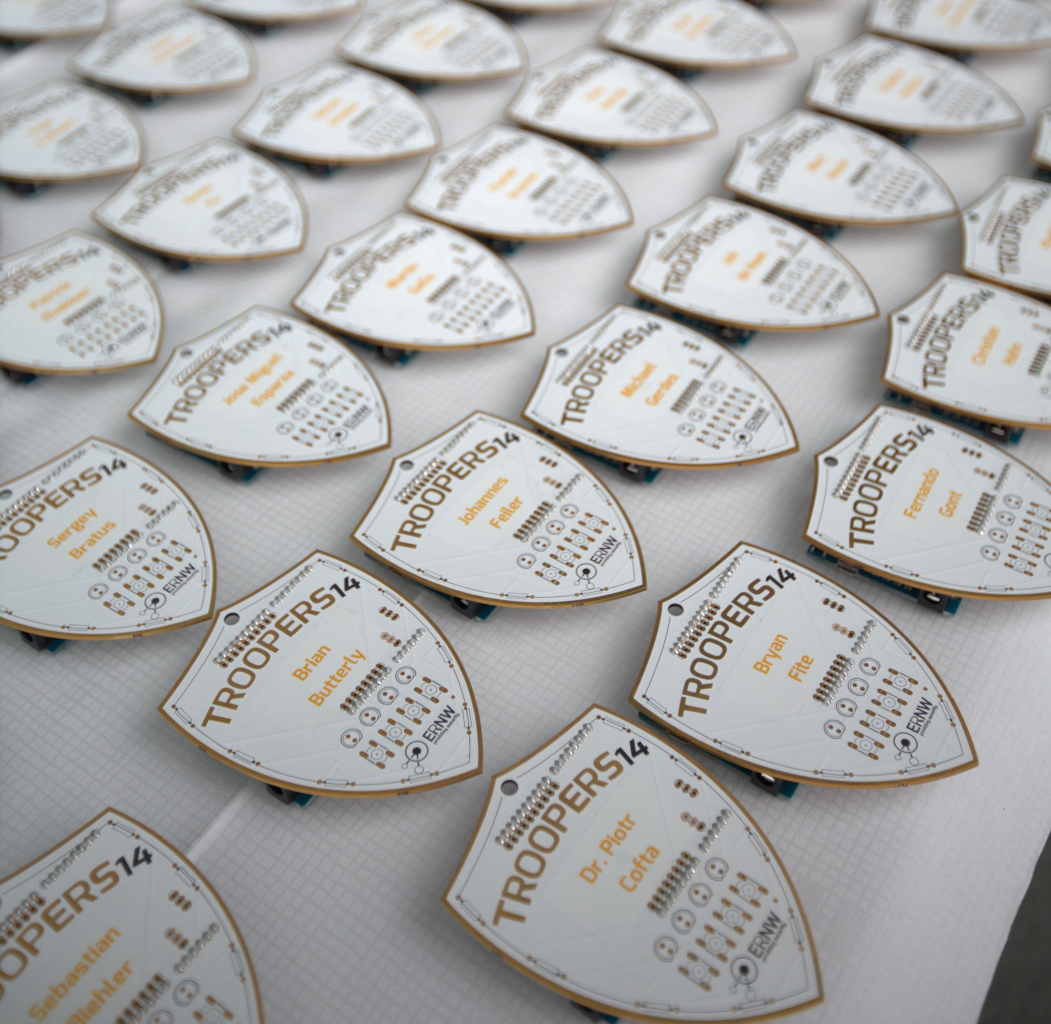
Greetings from the Print Media Academy in Heidelberg. Just in time for
TROOPERS14, I’ve got the great honor to present this years badge!
Being a TROOPER is tough: You need to know loads of information, learn even more
and be able to work fast.
This year we decided to increase your efficiency and speed when collecting data
from computer systems and, let’s say, hacking them! Your newest gadget is based
on a plain
Arduino Leonardo,
modded with one of our famous shields. After adding a few LEDs and buttons, it
will power up to full functionality.