After our last blogpost regarding Emotet and several other Emotet and Ransomware samples that we encountered, we recently stumbled across a variant belonging to the Gozi, ISFB, Dreambot respectively Ursnif family. In this blogpost, we want to share our insights from the analysis of this malware, whose malware family is mainly known for being a banking trojan that typically tries to infect browser sessions and sniff/redirect data. In particular, we are going to provide details about the first stage Word Document, the embedded JavaScript/XSL document, an in-depth runtime analysis of the downloaded executable, and some details regarding detection.
Continue reading Continue readingForensics
Comparison of our tool afro (APFS file recovery) with Blackbag Blacklight and Sleuthkit
At this years ARES conference, Jonas Plum (Siemens) and me (Andreas Dewald, ERNW Research GmbH) published a paper about the forensic analysis of APFS, file system internals and presented different methodologies for file recovery. We also publicly released a tool implementing our presented approaches, called afro (APFS file recovery).
APFS is the file system for Apple devices that is used by default on all current iOS mobile devices, as well as macOS since High Sierra, and is thus currently rolled out on a large number of devices. By using afro, we evaluated and compared the different approaches amongst each other and identified the method that so far delivers the best results and compared it to photorec. This showed that AFRO outperforms photorec on the evaluated APFS dataset. In the presentations of this research we were often asked if other tools like Blackbags Blacklight do not already support this recovery process. So, we decided to compare the file recovery capabilities of BlackLight and afro. We wanted to compare afro to the sleuth kit as well, as at the DFRWS conference it was discussed about adding APFS Support to The Sleuthkit Framework, but no implementations are public yet.
Continue reading Continue readingIncident Analysis and Digital Forensics Summit 2018, 14th of November of 2018
*This event will be held in German*
Inspiriert durch die erfolgreichen Round-Table-Diskussionen der Troopers-Konferenz freuen wir uns, Ihnen heute mit dem Incident Analysis and Digital Forensics Summit 2018, eine weitere Veranstaltung in einer Reihe zu Trend-Themen im Bereich der IT-Sicherheit vorzustellen.
Die Veranstaltung beginnt am Morgen mit einem Eröffnungsvortrag von Thomas Schreck (Chairman of the Board des internationalen CERT Verbunds FIRST), gefolgt von Fallstudien und Vorträgen durch weitere Referenten aus der Industrie und Strafverfolgung.
Continue reading Continue readingNew Release of Glibc Heap Analysis Plugins
After quite some time and work, I’m happy to announce the new release of the
Linux
Heap
Analysis
Plugins, which are now part of the Rekall
project, but not yet part of an official Rekall release, so you have to grab
them manually.
This release fixes several bugs and adds the following features:
- Support for Glibc version 2.26 (tcache chunks) and 2.27
- Heapsearch now includes Rekall’s yara scan functionality
- x86 Glibc versions with a modified MALLOC_ALIGNMENT value of 16 (as done in arch’s glibc package 2.26) are now supported
- Improved retrieval of main_arena and new automated retrieval of malloc_par struct; so for the majority of cases, the corresponding cmd line options are not necessary anymore and hence no debug information have to be retrieved.
- main_arena and malloc_par struct retrieval now also applies for statically linked binaries; there might however be cases, where it is necessary to specify the malloc_par struct offset and the used glibc version number
While Glibc version 2.27 does not really change much for the heap from a
forensics point of view, version 2.26 introduced a new feature called tcache
(per thread cache). Those caches are essentially just a new type of bin, holding
freed chunks, but
seem to improve the performance.
Sadly,
only two days after its
first commit,
there was already a blog post explaining
the functionality (not so sad 😉 ) and also some discovered vulnerabilities
(here we go with the sad part).
Besides introducing a new landscape for attackers, this feature added two new
heap management structs and one additional chunk per thread-heap (each thread
has its own heap, up until an upper limit). This chunk is located at the
beginning of each heap and hence, part of a raw heap dump (so be aware of that,
if you are doing a raw analysis without the plugins).
The chunk holds the content of the tcache_perthread_struct, which has to
members:
DFRWS USA 2017
As mentioned in my last blogpost, I had the pleasure to participate in this years DFRWS USA and present our paper. The paper and presentation can be freely viewed and downloaded here or here. Note that there is also an extended version of the paper, which can be downloaded here.
The keepassx, zsh and heap analysis plugins are now also part of the Rekall release candidate 1.7.0RC1, so it’s easier to get started.
The conference had some great talks and workshops, which I’m going to briefly sum up.
Continue reading Continue readingRelease of Glibc Heap Analysis Plugins for Rekall
I’m happy to announce the release of several Glibc heap analysis plugins (for Linux), resp. plugins to gather information from keepassx and zsh, which are now included in the Rekall Memory Forensic Framework. This blogpost will demonstrate these plugins and explain how they can be used. More detailed information, including real world scenarios, will be released after the talk at this years DFRWS USA.
Before being able to reliably analyze the heap of a process, a profile, for the Glibc version being used, must be provided. However, this step should for most cases be fairly simple and only consist of gathering the offset for the mp_ and main_arena variables:
Continue reading Continue readingFirst dedicated Forensic Computing Training at TR17
I am looking forward to our newly introduced dedicated Forensic Computing
Training at TR17!
We will start the first day with a detailed background briefing about Forensic
Computing as a Forensic Science, Digital Evidence, and the Chain of Custody. The
rest of the workshop we will follow the Order of Volatility starting with the
analysis of persistent storage using file system internals and carving, as well
as RAID reassembly with lots of hands-on case studies using open source tools.
As a next step, we will smell the smoking gun in live forensics exercises.
Depending on your preferences we will then dig a bit into memory forensics and
network forensics.
New Ransomware-Wave Analysis
In the context of a customer project, we examined a new variant of the Locky ransomware. As in the meantime stated by a law enforcement agency, this has been part of a large wave of attacks hitting various enterprises in the night from Tuesday (2016-07-26) to Wednesday.
As an initial attack vector, the attackers use emails with an attachment that probably even uses a 0day exploit, that enables the payload to be executed already when displayed in the MS Outlook preview.
Continue reading Continue readingDFRWS EU 2016 Summary
In this article, I want to provide a concise sum-up of the (to me) most interesting talks of this year’s DFRWS EU (http://www.dfrws.org/2016eu/).
Eoghan Casey, one of most famous pioneers in digital forensics, and David-Olivier Jaquet-Chiffelle, professor in police science at University of Lausanne, gave a keynote that emphasized the need for theoretical fundamental basis research in the field of digital forensics, which I fully agreed on, as this was exactly what I addressed in some of my former research.
Continue reading Continue readingGeneric RAID Reassembly using Block-Level Entropy
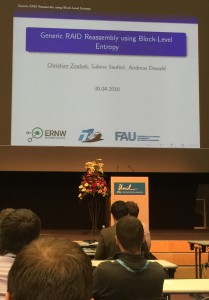
DFRWS EU 2016 Talk Forensic Raid Recovery
We just presented our Paper “Generic RAID Reassembly using Block-Level Entropy” at the DFRWS EU 2016 digital forensics conference (http://www.dfrws.org/). The article is about a new approach that we developed for forensic RAID recovery. Our technique calculates block-wise entropy all over the disks and uses generic heuristics on those to detect all the relevant RAID parameters such as stripe size, stripe map, disk order, and RAID type, that are needed to reassemble the RAID and make the data accessible again for forensic investigations (or just for data recovery).
Continue reading Continue reading