Recently I had the pleasure to join the
PowerOfCommunity conference in Seoul.
Florian and Felix attended the conference in the past and enjoyed it a lot, so I
took the opportunity to join this year. From what I had heard the conference is
highly technical, offensive security and community focused (surprise 😉 ). Boy
did they deliver!
Located in a hotel next to a nice park and close to the famous Gangnam district
in Seoul we came together to feel the power of community. The conference was
planned for two days and offered two tracks per day. Several key talks were
presented for everyone.
I really liked the topics a lot. Some contributions I found particularly
interesting were:
Petr Švenda with “The Million-Key Question – How RSA Public Key Leaks Its
Origin”, where he presented his research of fingerprinting RSA public keys. By
analyzing the RSA keys from smartcards and software sources he was able to find
similarities between them, which allowed fingerprinting the generating source
for some cases. With this information it could be possible gather some
potentially important details from simple keys. He is currently expanding his
work, please send him an E-Mail if you have RSA keys from an exotic resource. 😉
Benedikt Troester
Hek.si 2015
Hey!
I attended this really nice conference in Slovenia on April
16th. It was a smaller conference, but very memorable for the people (students,
IT sec professionals and managers alike) who attended.
I also had the pleasure to present
on How secure am I with EMET?
and
Evaluating the APT armor and
wanted to share the slides with you — feel free to approach me for any kind of
feedback or discussion.
I’m looking forward to go to Ljubljana again! 😉
Continue reading Continue readingTroopers PacketWars 2015 – Write Up
Hello Hackers!
This year’s PacketWars contest at Troopers was a blast! Under the topic of “Connected Car” the teams faced several different challenges, which we will describe (as a debriefing) here.
Story
From the Packetmaster’s Battle Briefing:
You and your krew are “freelancers” hired to identify and neutralize an unknown
threat agent who has created weaponized software and delivered it to civilian
Connected Cars via compromised EV (Electrical Vehicle) charing stations. To make
matters worse there are indications that new strains of the malware are
appearing as the “worm” spreads from car to car. The mobile mesh network created
by the Connect Car is highly resilient, allowing the malware to spread
exponentially. Time is of the essence.
Malware analysis suggests that besides a botnet module, there is an active
CANBus injection capability. There appears to be other modules but they haven’t
been properly reversed and analyzed yet.
HackInTheBox and Haxpo – 2014
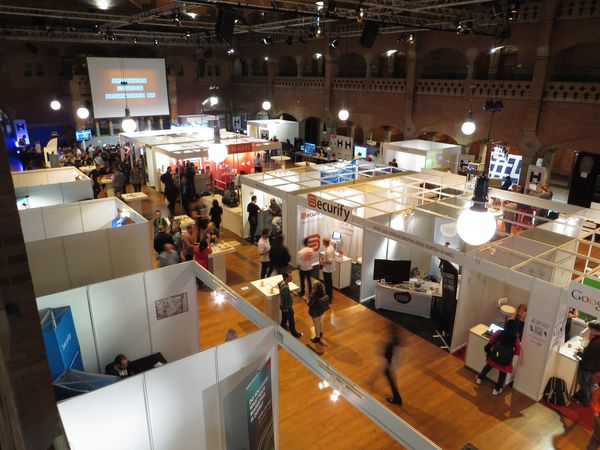
Haxpo Overview 2014
Past month we (which is me and a group of other ERNW students, supported by some of the “old” guys — I hope my team lead won’t yell at me for this 😉 ) attended the Haxpo and Hack in the Box in Amsterdam. Starting from 28. May, we had three days at this great conference (HITB) and exposition (Haxpo). The two events took place in the former building of the stock exchange in Amsterdam, called: “Beurs van Berlage”. Upon entering the building for the first time we were given details on where our booth was and where the talks would take place — setting up our booth and planning the shifts was just another thing to do before exploring the Haxpo area:
Continue reading Continue readingDjango Image Validation Vulnerability
Hi!
In the course of a recent penetration test, we came across an Image validation vulnerability in Django when using the Python-Imaging-Library (PIL) which we want to explain in this post.
Everybody who doesn’t know what Django and/or
the PIL is:
Django is a framework to create web applications with Python (comparable to
Rails or Zend). The PIL is a powerful standard python library which provides a
toolset to modify, display and verify images of many different formats.
ASCII Protocol Scheme Generator
As we historically have a strong connection to network technologies (not surprising, given the “NW” in “ERNW” stands for “Networks”), I developed a small script to create RFC-style ASCII representations of protocol schemes. The following listing shows an example created for a fictitious protocol:
 0                   1                   2                   3
 0 1 2 3 4 5 6 7 8 9 0 1 2 3 4 5 6 7 8 9 0 1 2 3 4 5 6 7 8 9 0 1
+---------------------------------------------------------------+
|             type              |              id               |
+---------------------------------------------------------------+
|     flags     |                   reserved                    |
+---------------------------------------------------------------+
|                            payload                            |
+---------------------------------------------------------------+
Continue reading Continue reading