A
quick update on the workshop we’ve just finished at
Hack in the Box 2012 Amsterdam:
Due
to popular demand we decided to bring the slides online without wasting any more
time. The official website of the conference is currently experiencing some
problems due to high interest in all the stuff what was released in the last two
days. Great conference!
Update #1: Slides are available for download
here.
In the course of our ongoing
cloud security research,
we’re continuously thinking about potential attack vectors against public cloud
infrastructures. Approaching this enumeration from an external customer’s
(speak: attacker’s 😉 ) perspective, there are the following possibilities to
communicate with and thus send malicious input to typical cloud infrastructures:
Management interfaces
Guest/hypervisor interaction
Network communication
File uploads
As there are already several successful exploits against management interfaces
(e.g.
here
and here) and
guest/hypervisor interaction (see for example
this one; yes,
this is the funny one with that ridiculous recommendation “Do not allow
untrusted users access to your virtual machines.” ;-)), we’re focusing on the
upload of files to cloud infrastructures in this post. According to our
experience with major Infrastructure-as-a-Service (IaaS) cloud providers, the
most relevant file upload possibility is the deployment of already existing
virtual machines to the provided cloud infrastructure. However, since a quick
additional research shows that most of those allow the upload of VMware-based
virtual machines and, to the best of our knowledge, the VMware virtualization
file format was not analyzed as for potential vulnerabilities yet, we want to
provide an analysis of the relevant file types and present resulting attack
vectors.
Reading
this advisory
I’m quite tempted to emit another rant on the relationship of heavy use of 3rd
party components, lack of (security) quality assurance and services running at
times where they’re not needed (see second workaround
here).
I’ll refrain from that for today. Just wanted to let you know that the
underlying vulnerability
in Struts2 was initially discovered by Meder Kydyraliev who gives
this talk
at Troopers in two weeks. He’ll certainly describe the
inner workings of this one, and others… 😉
Just wanted to let you know that we sent out
ERNW Newsletter 32
end of last week. As we
promised
it includes the results of research regarding the question “Is browser
virtualization a valid security control in order to mitigate browser based
security risks?”.
Simon did a great job with writing the latest newsletter. It’s a 30-page
document which should help you to have a basis for well-informed decisions when
it comes to the deployment of an application virtualization technology.
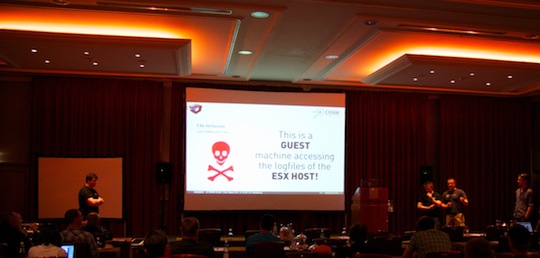 A
quick update on the workshop we’ve just finished at
Hack in the Box 2012 Amsterdam:
A
quick update on the workshop we’ve just finished at
Hack in the Box 2012 Amsterdam: