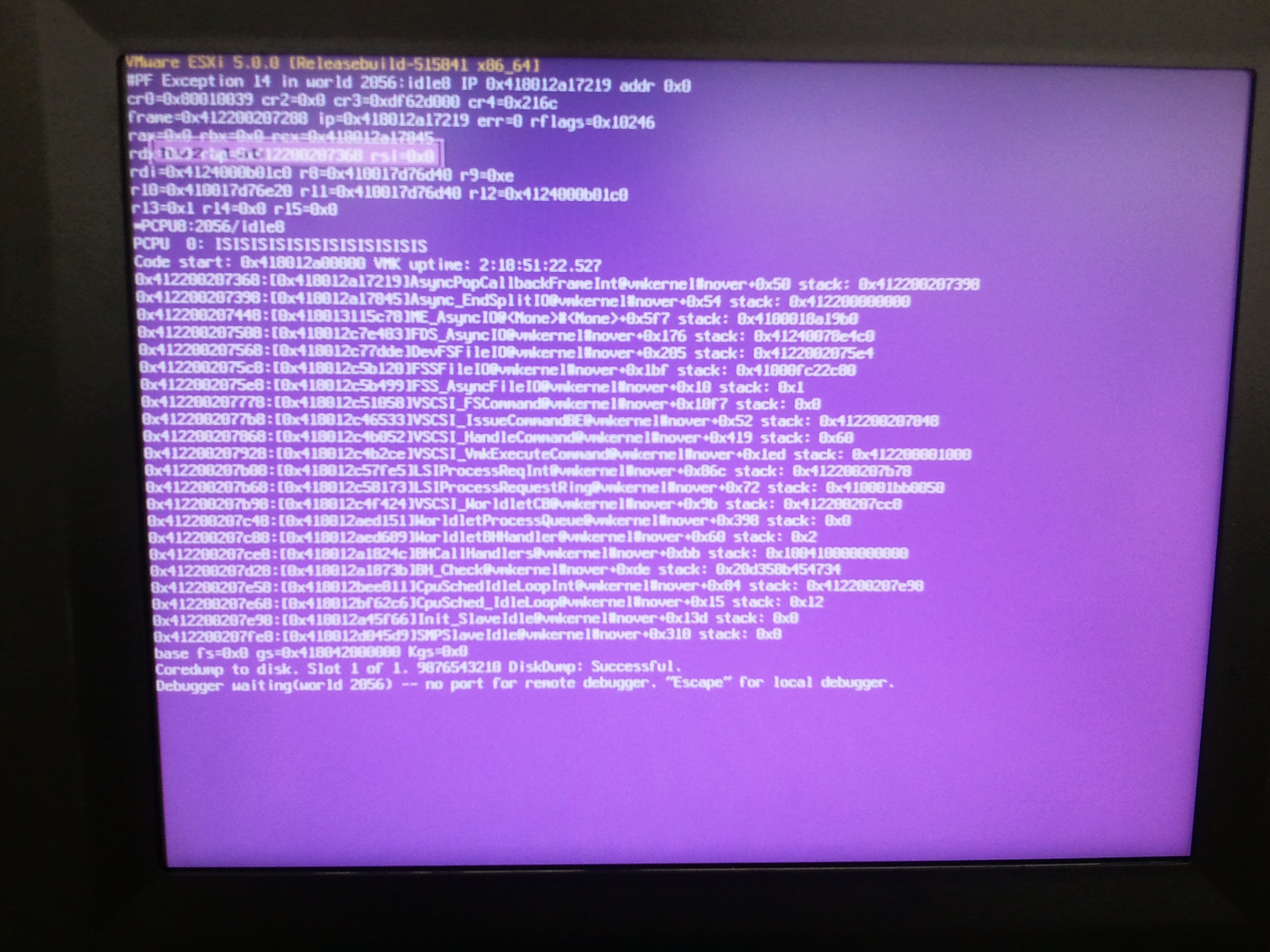
Almost all of our presentations and write-ups on the VMDK File Inclusion
Vulnerability contained a slide stating something like
“we’re rather sure that DoS is possible as well ;-)”
including the following screenshot of the ESX purple screen of death:
So it seems like we still owe you that one — sorry for the delay! However the
actual attack to trigger this purple screen was rather simple: Just include
multiple VMDK raw files that cannot be aligned with 512 Byte blocks — e.g.
several files of 512 * X + [0 < Y < 512] Bytes. Writing to a virtual hard
drive composed of such single files for a short amount of time (typically one to
three minutes, this is what we observed in our lab) triggered the purple screen
on both ESXi4 and ESXi5 — at least for a patch level earlier than
Releasebuild-515841/March 2012: it seems like this vulnerability was patched in
Patch
ESXi500-201203201-UG.
In our last series of posts regarding the VMDK file inclusion attack, we focused
on read access
and
prerequisites
for the attack, but avoided stating too much about potential write access. But
as we promised to cover write access in the course of our future research, the
following post will describe our latest research results.
First of all, the same
prerequisites
(which will be refined a little bit more later on) as for read access must be
fulfilled and the same
steps have to
be performed in order to carry out the attack successfully. If that is the case,
there are several POIs (Partitions Of Interest) on a ESXi hypervisor that are
interesting to include:
As we are receiving a lot of questions about our
VMDK has left the building post,
we’re compiling this FAQ post — which will be updated as our research goes on.
** **
How does the attack essentially work?
By bringing a specially crafted VMDK file into a VMware ESXi based
virtualization environment. The specific attack path is described
here.
* *
What is a VMDK file?
A combination of two different types of VMDK files, the plain-text descriptor
file containing meta data and the actual binary disk file, describes a VMware
virtual hard disk. A detailed description can be found
here.
As announced at last week’s
#HITB2012AMS, I’ll describe
the fuzzing steps which were performed during our initial research. The very
first step was the definition of the interfaces we wanted to test. We decided to
go with the plain text VMDK file, as this is the main virtual disk description
file and in most deployment scenarios user controlled, and the data part of a
special kind of VMDK files, the Host Sparse Extends.