In the course of a current virtualization research project, I was reviewing a lot of documentation on hypervisor security. While “hypervisor security” is a very wide field, hypervisor breakouts are usually one of the most (intensely) discussed topics. I don’t want to go down the road of rating the risk of hypervisor breakouts and giving appropriate recommendations (even though we do this on a regular base which, surprisingly often, leads to almost religious debates. I know I say this way too often:I’ll cover this topic in a future post ;)), but share a few observations of analyzing well-known examples of vulnerabilities that led to guest-to-host-escape scenarios. The following table provides an overview of the vulnerabilities in question:
Continue reading Continue readingMatthias Luft
Thoughts on Cloud Governance, Part 1
Last week Rapid7 posted an interesting analysis of the Amazon S3 storage system: Apparently roughly one out of six S3 buckets (a bucket is, simply said, a kind of folder) is accessible without any authentication mechanism. Accessing those files, the Rapid7 guys were able to download a wide range of data, also comprising confidential information such as source code or employee information, comparable to past research for other platforms (see also this presentation I gave on some of the biggest Cloud #Fails)
Continue reading Continue readingBPDU Guard: Bringing Down Infrastructures
As you may already be familiar with some of our previous work which was mainly focused on isolation issues of hypervisors, we also want to present you an issue concerning availability in Cloud environments. This issue was already covered in some of our presentations, but will be explained in greater detail in this blog post.
In the course of one of our security assessments of a public IaaS Cloud environment, we experienced the following network setting:
Continue reading Continue readingBASTA! Spring 2013
Yesterday I was giving two presentations about Cloud security at the BASTA! Spring 2013 Security Day. While my presentations covered Microsoft Azure security considerations (which also included a part of the Cloud security approach covered in our workshops; slides available here) and some major Cloud incidents (suitable to transport different messages about Cloud security in general ;); slides available here), I also saw Dominick’s very interesting presentation about security aspects and changes in Windows 8. Inspired by that, we hope to be able to publish another blogpost on those aspects with regard to enterprise environments soon — most likely we won’t find any time for it before TROOPERS 😉
Continue reading Continue readingVMDK Has Left the Building — Newsletter
We are pleased to announce that we summarized the results from our VMDK research in our latest newsletter.
We hope you enjoy the reading and will get some “food for thought”!
The newsletter can be found at:
ERNW_Newsletter_41_ExploitingVirtualFileFormats.pd
A digitally signed version can be found at:
ERNW_Newsletter_41_ExploitingVirtualFileFormats_signed.pdf
Enjoy your weekend,
Matthias
VMDK Has Left the Building — Denial of Service
Almost all of our presentations and write-ups on the VMDK File Inclusion Vulnerability contained a slide stating something like
“we’re rather sure that DoS is possible as well ;-)”
including the following screenshot of the ESX purple screen of death:
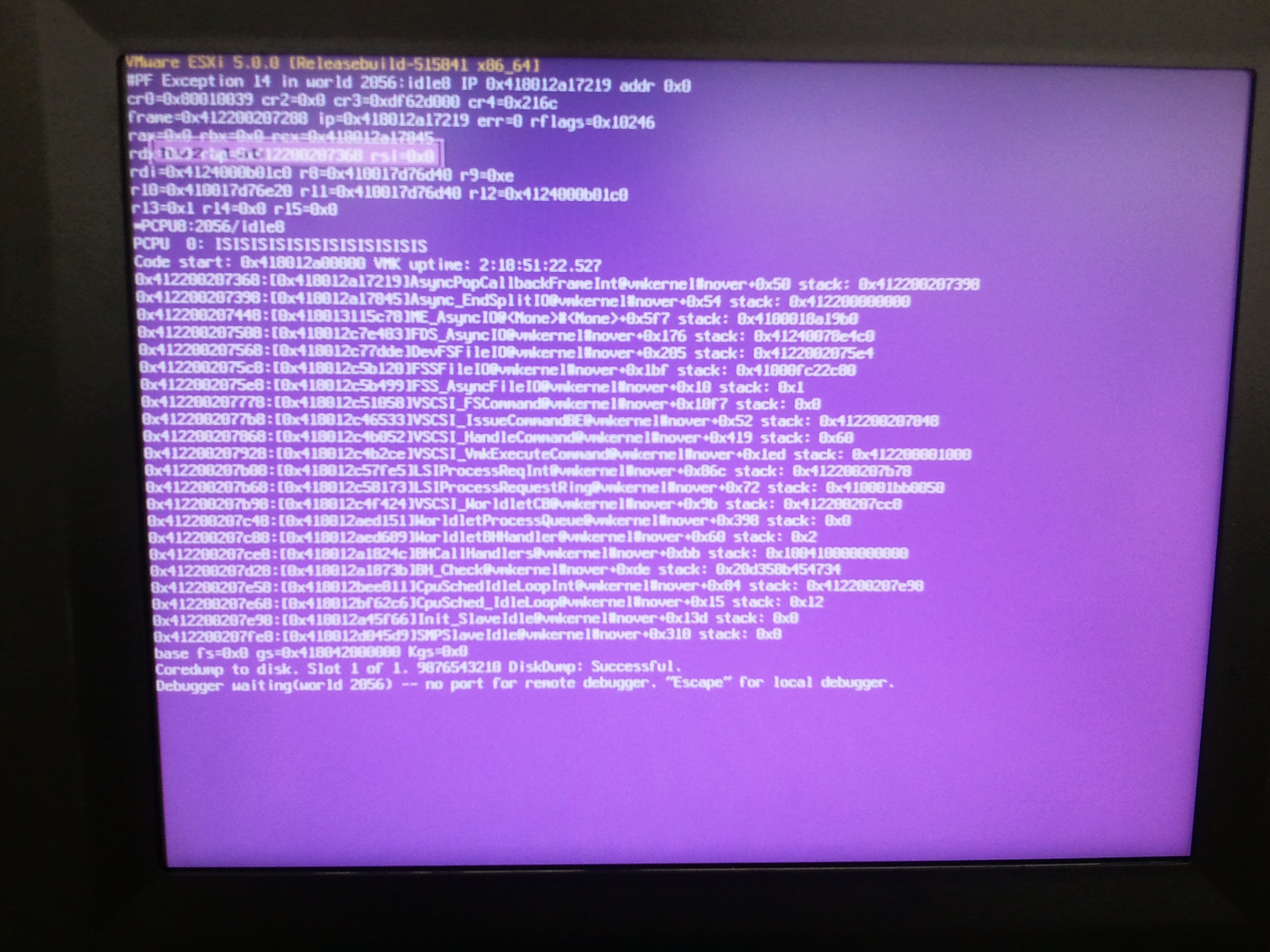
So it seems like we still owe you that one — sorry for the delay! However the actual attack to trigger this purple screen was rather simple: Just include multiple VMDK raw files that cannot be aligned with 512 Byte blocks — e.g. several files of 512 * X + [0 < Y < 512] Bytes. Writing to a virtual hard drive composed of such single files for a short amount of time (typically one to three minutes, this is what we observed in our lab) triggered the purple screen on both ESXi4 and ESXi5 — at least for a patch level earlier than Releasebuild-515841/March 2012: it seems like this vulnerability was patched in Patch ESXi500-201203201-UG.
Continue reading Continue readingDAY-CON VI
As every year, we will be attending Day-Con, a one-day security summit in Dayton, OH — this year for its VIth edition. Even though the actual conference comprises “only” one day full with talks and discussions (please find the agenda here), the overall event consists of trainings before the conference and PacketWars battles (including an infamous party) afterwards. Since we will be leading and attending some of the training sessions, those might be of particular interest for people who missed our Troopers workshops — so you don’t have to wait a whole year but get another chance in October 😉
Continue reading Continue readingVMDK Has Left the Building — FAQ
As we are receiving a lot of questions about our VMDK has left the building post, we’re compiling this FAQ post — which will be updated as our research goes on.
** **
How does the attack essentially work?
By bringing a specially crafted VMDK file into a VMware ESXi based virtualization environment. The specific attack path is described here.
* *
What is a VMDK file?
A combination of two different types of VMDK files, the plain-text descriptor file containing meta data and the actual binary disk file, describes a VMware virtual hard disk. A detailed description can be found here.
Continue reading Continue readingVMDK Has Left the Building — Some Nasty Attacks Against VMware vSphere 5 Based Cloud Infrastructures
Update #1: Slides are available for download here.
In the course of our ongoing cloud security research, we’re continuously thinking about potential attack vectors against public cloud infrastructures. Approaching this enumeration from an external customer’s (speak: attacker’s 😉 ) perspective, there are the following possibilities to communicate with and thus send malicious input to typical cloud infrastructures:
- Management interfaces
- Guest/hypervisor interaction
- Network communication
- File uploads
As there are already several successful exploits against management interfaces (e.g. here and here) and guest/hypervisor interaction (see for example this one; yes, this is the funny one with that ridiculous recommendation “Do not allow untrusted users access to your virtual machines.” ;-)), we’re focusing on the upload of files to cloud infrastructures in this post. According to our experience with major Infrastructure-as-a-Service (IaaS) cloud providers, the most relevant file upload possibility is the deployment of already existing virtual machines to the provided cloud infrastructure. However, since a quick additional research shows that most of those allow the upload of VMware-based virtual machines and, to the best of our knowledge, the VMware virtualization file format was not analyzed as for potential vulnerabilities yet, we want to provide an analysis of the relevant file types and present resulting attack vectors.
Continue reading Continue readingNo Connectivity — No Malware Protection
During a recent penetration test, we evaluated the security of a typical corporate employee notebook. It was to be assessed whether employees with a default corporate user account would be able to gain administrative access and subsequently abuse the system for attacks against a certain high value database system. When evaluating this problem set, the first step is to find ways to bring tools and exploit code on the system. Usually this task requires the bypassing of the malware protection agent of the system. At some point, we thought we figured a way to encode exploits and payloads in a way that would not be detected by the malware protection solution.
Continue reading Continue reading